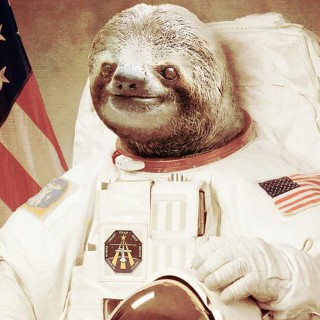
Hello there, friends.
Download transcript (.vtt)
0:00
0:01
0:05
0:09
0:11
0:13
0:21
0:26
0:29
0:32
0:34
0:38
0:45
0:50
0:53
0:57
1:02
1:08
1:14
1:20
1:20
1:21
1:22
1:24
1:32
1:35
1:39
1:43
1:49
1:51
1:55
1:59
2:02
2:11
2:13
2:19
2:20
2:22
2:26
2:30
2:39
2:42
2:44
2:48
2:56
3:02
3:04
3:07
3:10
3:13
3:16
3:17
3:18
3:22
3:36
3:39
3:40
3:49
3:56
3:59
4:01
4:08
4:13
4:14
4:16
4:17
4:18
4:21
4:22
4:26
I'm your host, Captain Sergio, though most people just call me Sergio.
I'm a sloth, an astronaut sloth to be specific.
And welcome to Hangtime.
I know what you're thinking.
Sergio, shouldn't astronauts be, you know, fast, alert, ready to respond to emergencies in milliseconds
And sure, that's what they taught me at NASA orientation, but then I asked them a question.
Have you ever actually looked at space?
Space is really big and really slow.
Planets take centuries to orbit.
Light from distant stars takes millions of years to reach us.
A photon traveling at the speed of light still has to wait around for billions of years before anything interesting happens.
So actually I think sloths are perfectly suited for space exploration.
Took me 45 minutes to say that sentence, by the way.
Sorry, so here's what this podcast is about.
Every episode, I'm going to tell you about something amazing happening out there in the cosmos.
We'll talk about black holes, supernovas, exoplanets, the Big Bang, all the heavy stuff.
And we'll do it at a pace that actually lets us appreciate how absolutely mind-bending it all is.
No rushing, no stressing, just me, you and the infinite universe hanging out together.
Get it?
Hanging?
Out?
I'll be here all season.
Now I should probably tell you how I became an astronaut, since that's probably the question you're wondering about while listening to a sloth talk about space
I grew up in the rainforests of Costa Rica.
Very peaceful, very green, very slow-paced.
My family had a nice tree, a sacropia tree, if you want to get specific.
And I spent my days doing what sloths do, eating leaves, napping, existing.
Life was good, simple.
But then one night I looked up and I saw the stars.
Now I'd seen stars before, obviously, I'm not that slow.
But this particular night I really saw them.
Not just dots of light, but actual burning balls of plasma, light years away, possibly with their own planets and their own strange creatures.
And I thought, I want to understand that.
It took me six months to climb down from the tree to tell my mother about my dream.
But she understood.
Mothers do.
Turns out, there's a whole application process for astronauts.
Medical exams, psychological evaluations, IQ tests.
The NASA people looked at my slow metabolism and my incredible body density, which makes me more fuel efficient in zero gravity by the way.
And they decided to take a chance on me.
The training was interesting.
A lot of centrifuges, a lot of people yelling, faster Sergio.
A lot of me moving at my own pace and eventually getting the same results as the other trainees, just in a different time frame.
But here's the thing: when you're trying to memorize spacecraft systems or understand orbital mechanics,
Moving slowly is actually an advantage.
You don't make as many careless mistakes.
Last year I went to space for the first time.
I spent three months on the International Space Station.
And you want to know the most amazing thing about it?
The view.
Of course.
But also, and this might sound strange, the quiet.
You're in a machine hurtling around the earth at seventeen thousand five hundred miles per hour, and inside there's just this gentle hum, this permanent, constant reminder that you're alive, suspended above a world so beautiful it makes you want to cry.
I floated near a window for hours.
Days maybe.
Time moves differently up there, and I realized that this, all of this, is worth the slow journey, worth every moment it takes to get here
So that's what we're going to explore together on this podcast: the things that make the universe worth taking our time to understand.
Next episode, we're talking about the sun.
Specifically, why it's about 4.
6 billion years old, and what happens when you try to explain that number while your brain is also processing that 99.
86% of the mass in our entire solar system is literally just.
The sun.
It's a lot to hang with.
Sorry.
Hang with.
More of those jokes coming, I'm afraid.
I've got time.
Until then, this is Captain Sergio, reminding you to look up.
The stars aren't going anywhere, and neither am I